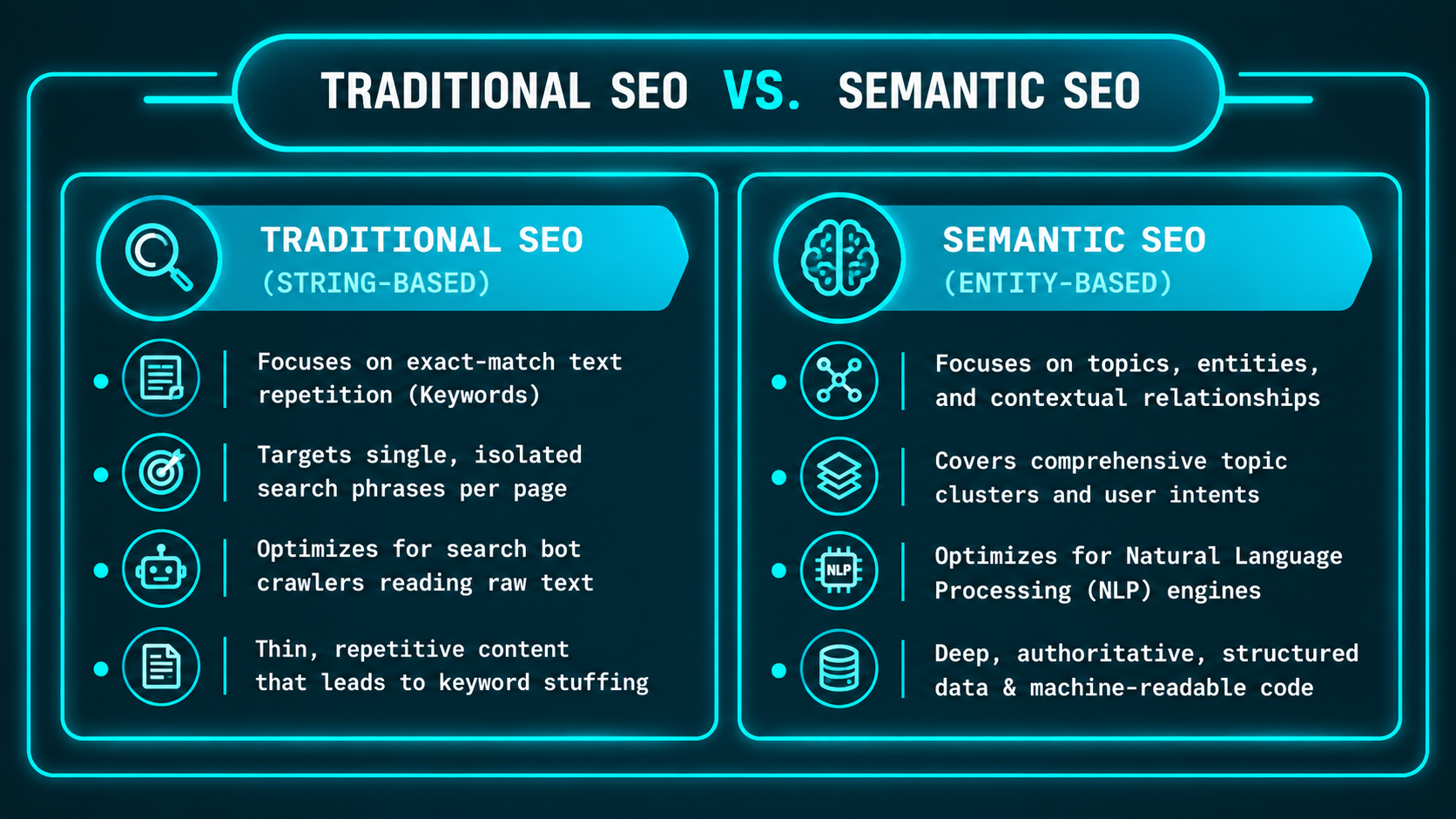
For years, digital marketing for small businesses operated on a relatively simple concept: strings of text. If you wanted to rank a website for local customers, you identified a target keyword phrase such as “plumber in Houston” or “auto repair shop near me” and repeated that exact string across your page titles, headings, meta tags, and body paragraphs.
Search engines were essentially glorified keyword-matching machines. They looked for exact character strings on your page and counted how many times they appeared.
In 2026, search algorithms no longer treat language as isolated strings of characters. Google, Bing, SearchGPT, and Perplexity understand language through entities, relationships, and context.
This fundamental shift is called Semantic SEO.
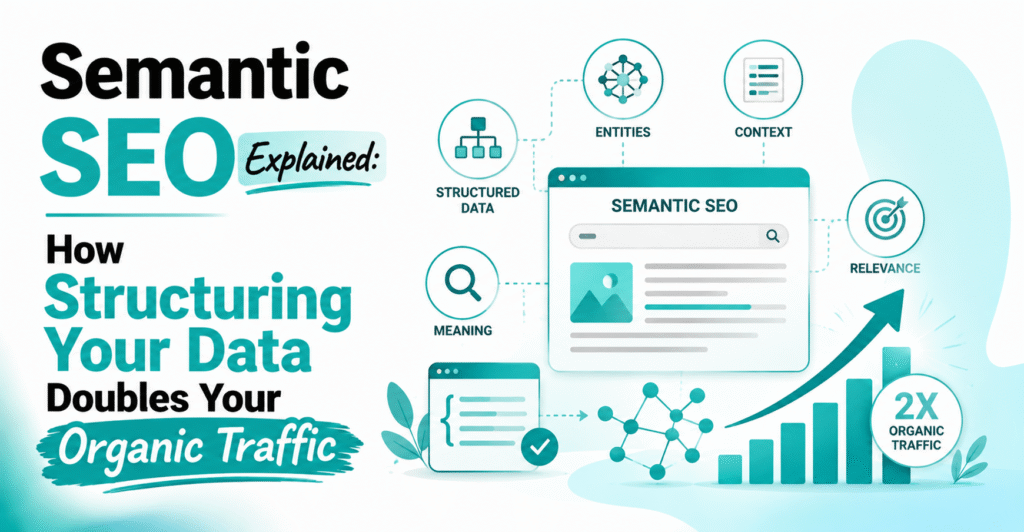
If your website still relies on old-school keyword repetition rather than structured entity mapping, topical depth, and Schema architecture, search engines will struggle to understand the full context of your services. Conversely, small businesses that adopt a semantic search framework can significantly expand their organic search reach, capture high-intent buyer traffic, and increase overall conversion rates.
This comprehensive guide explains how Semantic SEO works, why structured data is essential for modern search engines, and how local service businesses across the USA can implement a semantic content strategy.
What is Semantic SEO? (Strings vs. Entities)
Semantic SEO is the process of optimizing web pages around underlying concepts, real-world entities, and topical intent rather than isolated, repetitive keywords.
The Difference: Strings vs. Entities
- A String: A static sequence of letters (e.g.,
"b-r-a-k-e-r-e-p-a-i-r"). Old search algorithms looked for exact matches of this string across web pages. - An Entity: A well-defined, real-world concept, object, person, organization, or place that exists in Google’s Knowledge Graph (e.g., Brake System, Hydraulic Fluid, Rotors, ASE Certification, Automotive Repair Facility).
When you build web pages using Semantic SEO, you don’t just tell Google, “We do brake repair.” You provide a complete ecosystem of contextually related entities, technical specs, local geography details, and structured JSON-LD Schema code. This gives search engines the confidence needed to recommend your business for hundreds of long-tail search variations.
The Science: How Natural Language Processing (NLP) Understands Your Business
Modern search engines utilize advanced AI architectures and Natural Language Processing (NLP) models such as Google’s MUM, Gemini, and BERT frameworks to parse unstructured web content.
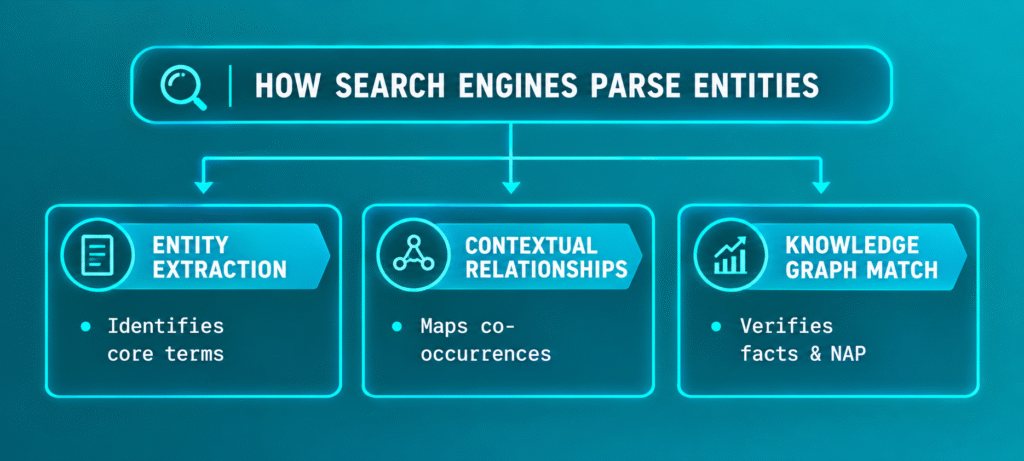
When search engines crawl your service pages, they execute three core semantic evaluations:
- Entity Extraction: The algorithm scans your content to identify core entities (e.g., Tankless Water Heater, Annual Maintenance, PSI Pressure Testing, Licensed Journeyman Plumber).
- Contextual Co-occurrence Analysis: The AI evaluates whether your content naturally includes the secondary terms expected of a true industry expert. If an HVAC page discusses “heat pump installation” but omits terms like “refrigerant lines,” “SEER2 rating,” “compressor,” and “thermostat wiring,” the algorithm concludes the content lacks depth.
- Knowledge Graph Matching: The engine cross-references your website data with third-party sources (e.g., Google Business Profile, Apple Maps, business registrations, trade directories) to verify that your business entity is legitimate and authoritative.
💡 Is Your Website Missing Semantic Entity Authority?
Stop relying on outdated keyword tactics that limit your online visibility. Let our technical team run a complete semantic audit of your site architecture and Schema markup.
4 Core Pillars of a Small Business Semantic SEO Strategy
To double your organic reach and build topical authority, implement these four core pillars of semantic optimization:
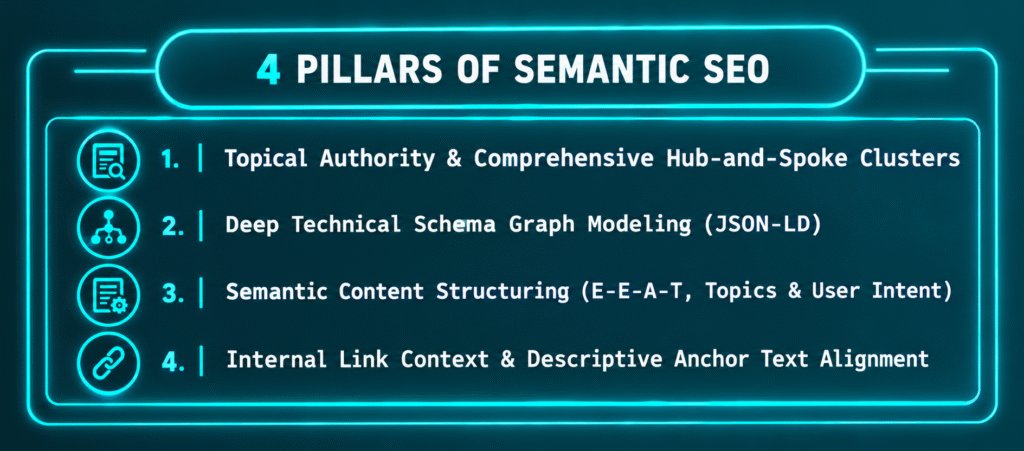
1. Topical Authority & Hub-and-Spoke Content Clusters
Instead of publishing isolated, scattered blog posts, structure your website using Topical Hub-and-Spoke Architecture.
- Pillar Page (The Hub): A comprehensive, high-level overview of a major service category (e.g., The Complete Guide to Residential HVAC Systems).
- Cluster Pages (The Spokes): Dedicated, highly specialized sub-pages addressing specific sub-topics, questions, or specialized services (e.g., Ductless Mini-Split Installation, Seasonal Heat Pump Troubleshooting, AC Compressor Replacement Costs).
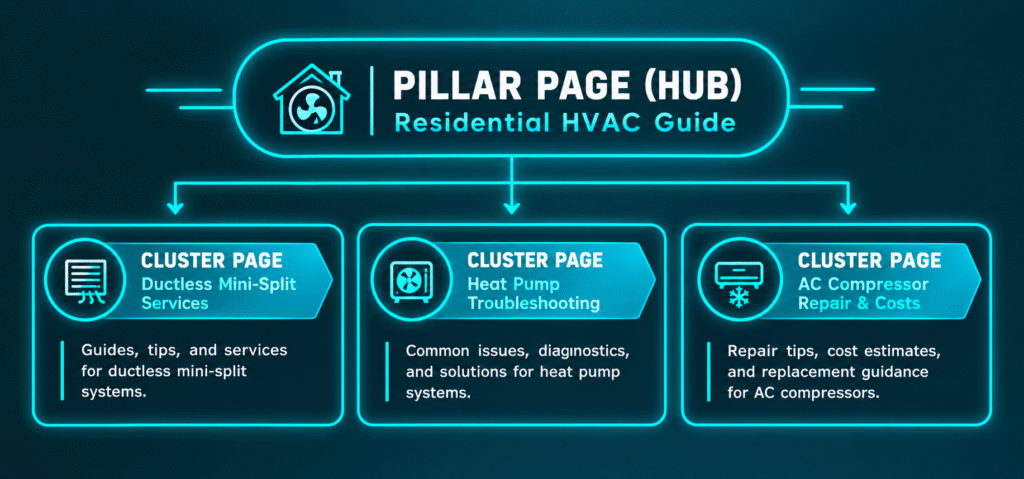
By interlinking the hub page with its cluster spokes, you signal to search engines that your site possesses complete topical coverage of that service area.
2. Deep Technical Schema Graph Modeling (JSON-LD)
Schema markup serves as machine-readable code that explicitly tells search engines what your content represents.
For local service businesses, basic Schema is no longer enough. Your site should utilize Nested Schema Graph Architecture, connecting multiple entity types within a single JSON-LD block:
{
“@context”: “https://schema.org”,
“@graph”: [
{
“@type”: “LocalBusiness”,
“@id”: “https://codixmedia.com/#business”,
“name”: “Your Local Service Business”,
“url”: “https://codixmedia.com”,
“telephone”: “+1-000-000-0000”,
“priceRange”: “$$”,
“address”: {
“@type”: “PostalAddress”,
“streetAddress”: “123 Main St”,
“addressLocality”: “Your City”,
“addressRegion”: “ST”,
“postalCode”: “00000”,
“addressCountry”: “US”
}
},
{
“@type”: “Service”,
“@id”: “https://codixmedia.com/#service”,
“serviceType”: “Emergency Plumbing Repair”,
“provider”: {
“@id”: “https://codixmedia.com/#business”
},
“areaServed”: {
“@type”: “City”,
“name”: “Your City”
},
“knowsAbout”: [
“Water Heater Repair”,
“Leak Detection”,
“Sewer Line Inspection”
]
}
]
}
This nested graph explicitly defines the relationship between your physical business, your geographical service area, and your specific technical capabilities.
3. Semantic Content Structuring (Direct Answers & Tables)
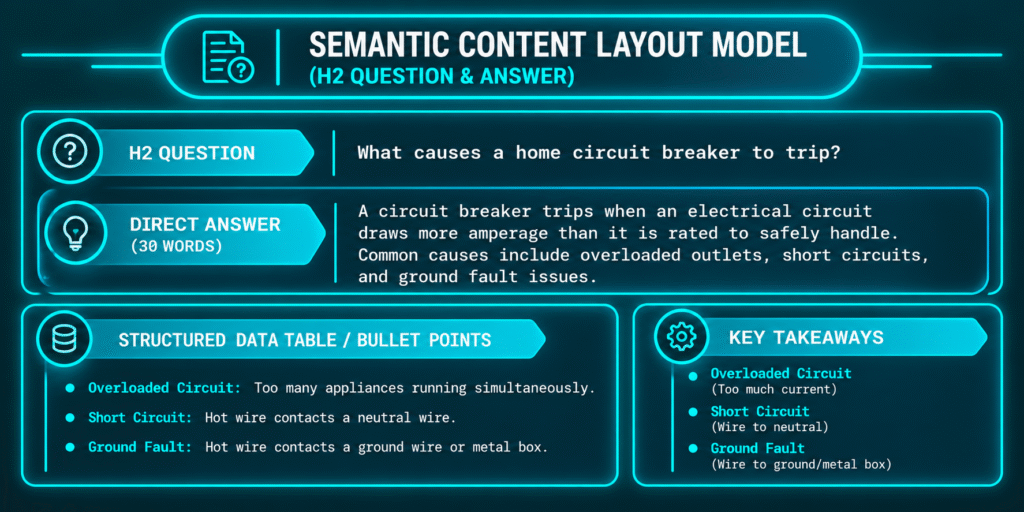
Organize your web page content so both human visitors and AI search engines can easily digest key facts:
- Use Explicit Subheading Prompts: Frame $H2$ and $H3$ subheadings as conversational questions (e.g., “How long does a ceramic coating application take?”).
- Provide Immediate Summary Statements: Include a clear, 30-word direct answer immediately below the heading before expanding into technical details.
- Present Structured Data Visually: Use bulleted lists and Markdown comparison tables to present pricing tiers, service features, and step-by-step processes.
4. Internal Link Context and Anchor Text Optimization
Avoid generic internal link text like “click here” or “read more.” Instead, use descriptive, entity-rich anchor text that clearly explains what the target page contains:
- Weak Anchor Text: “To learn about our brake services, [click here].”
- Semantic Anchor Text: “Learn more about our comprehensive [hydraulic brake repair and rotor resurfacing services].”
Descriptive anchor text provides clear contextual signals to search crawlers as they pass through your site.
Step-by-Step Action Plan: Implementing Semantic SEO on Your Site
Follow this systematic roadmap to upgrade your small business website to a semantic search framework:
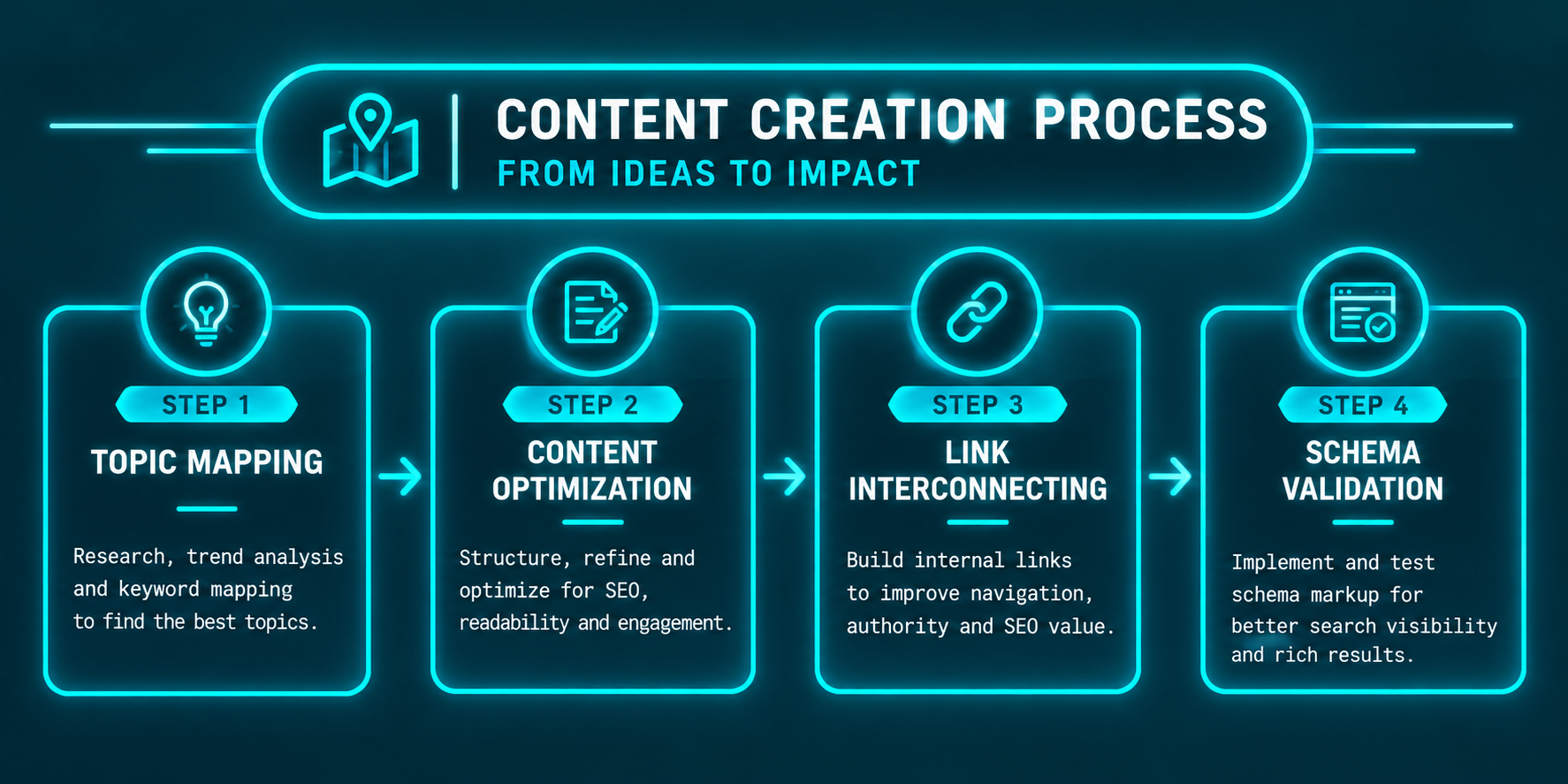
Step 1: Map Out Service Topic Clusters
Take your primary revenue services (e.g., Auto Repair, Electrical, Plumbing, HVAC, Detailing) and break them down into comprehensive topic clusters. Identify all related sub-services, common troubleshooting scenarios, pricing questions, and maintenance procedures.
Step 2: Optimize On-Page Content for Entity Depth
Review your core landing pages and expand their topical context:
- Add dedicated Q&A sections addressing real customer questions.
- Naturally incorporate related technical terminology and industry entities.
- Structure service comparisons using bullet points and data tables.
Step 3: Interlink Related Service Pages
Connect your cluster pages to their parent pillar page using contextual anchor text. Ensure every sub-service page links back to the main category hub to reinforce your site hierarchy.
Step 4: Deploy and Validate JSON-LD Schema
Generate validation-tested JSON-LD Schema code using tools like Google’s Rich Results Test or Schema.org validators. Deploy the code across your website to ensure search crawlers parse your entity graph without technical errors.
📊 Want to Expand Your Organic Search Reach?
Transitioning to a semantic search model helps your site capture high-intent buyer traffic across hundreds of long-tail search queries. Let our specialized team upgrade your website’s search architecture.
How CodixMedia Drives Technical & Semantic Search Growth
At CodixMedia, we help local service providers, contractors, auto repair facilities, and home service companies build search platforms designed for modern AI algorithms.
Our technical search services include:
- Semantic SEO & Entity Architecture: Comprehensive topic cluster mapping, entity enrichment, and Schema graph deployment.
- Google Business Profile Mastery: Full-scale Google Business Profile Management to translate web authority into Top 3 Map Pack rankings.
- Conversion-Focused Web Development: Fast, Schema-powered Website Development Services engineered for both human visitors and search crawlers.
- Targeted Search Advertising: High-ROI PPC Campaign Management to capture immediate customer demand across all search formats.
Ready to Double Your Organic Search Traffic?
Stop relying on outdated keyword tactics that limit your site’s potential. Partner with an agency that knows how to structure your online presence for long-term growth across Google, ChatGPT, and AI search engines.
👉 Schedule Your Strategy Call with CodixMedia Today or review our real-world client results on the CodixMedia Portfolio.