Search engine behavior has fundamentally changed. For over two decades, local marketing relied on a familiar pattern: a customer typed a short keyword into Google, scanned a list of ten blue links or a map pack, clicked a website link, and browsed pages to find an answer.
In 2026, over 60% of search queries end without a single click.
When a homeowner’s furnace fails in the middle of a freeze, an auto owner needs specialized paint protection or emergency mechanical work, or a commercial building experiences a major electrical fault, consumers don’t want to dig through websites. They use voice assistants (Siri, Alexa, Google Assistant) or AI answer engines (Google AI Overviews, Perplexity, ChatGPT, Gemini) to ask natural, conversational questions:
“Hey Siri, who is the highest-rated emergency plumber near me open right now that doesn’t charge extra weekend call-out fees?”
“OK Google, what is the average cost of a 2-stage HVAC unit installation in a 2,000 square foot house?”
In these zero-click search environments, AI engines do not offer a list of options. They select a single, direct, definitive answer and read it aloud or display it at the very top of the screen.
If your business isn’t optimized to be that single chosen response, your brand becomes completely invisible to modern voice and AI searchers.
This comprehensive guide breaks down Answer Engine Optimization (AEO) and gives local service businesses an actionable blueprint to win voice search queries, capture featured snippets, and dominate AI-driven answers.
What is Answer Engine Optimization (AEO)?
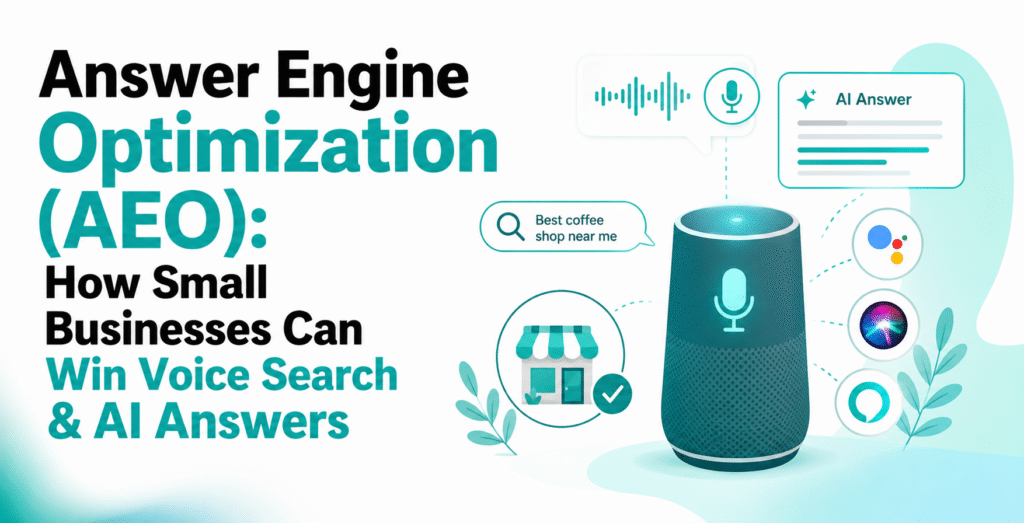
Answer Engine Optimization (AEO) is the practice of structuring, formatting, and semantically optimizing your digital content so that artificial intelligence systems, Large Language Models (LLMs), and voice assistants select your business as the direct, definitive response to user queries.
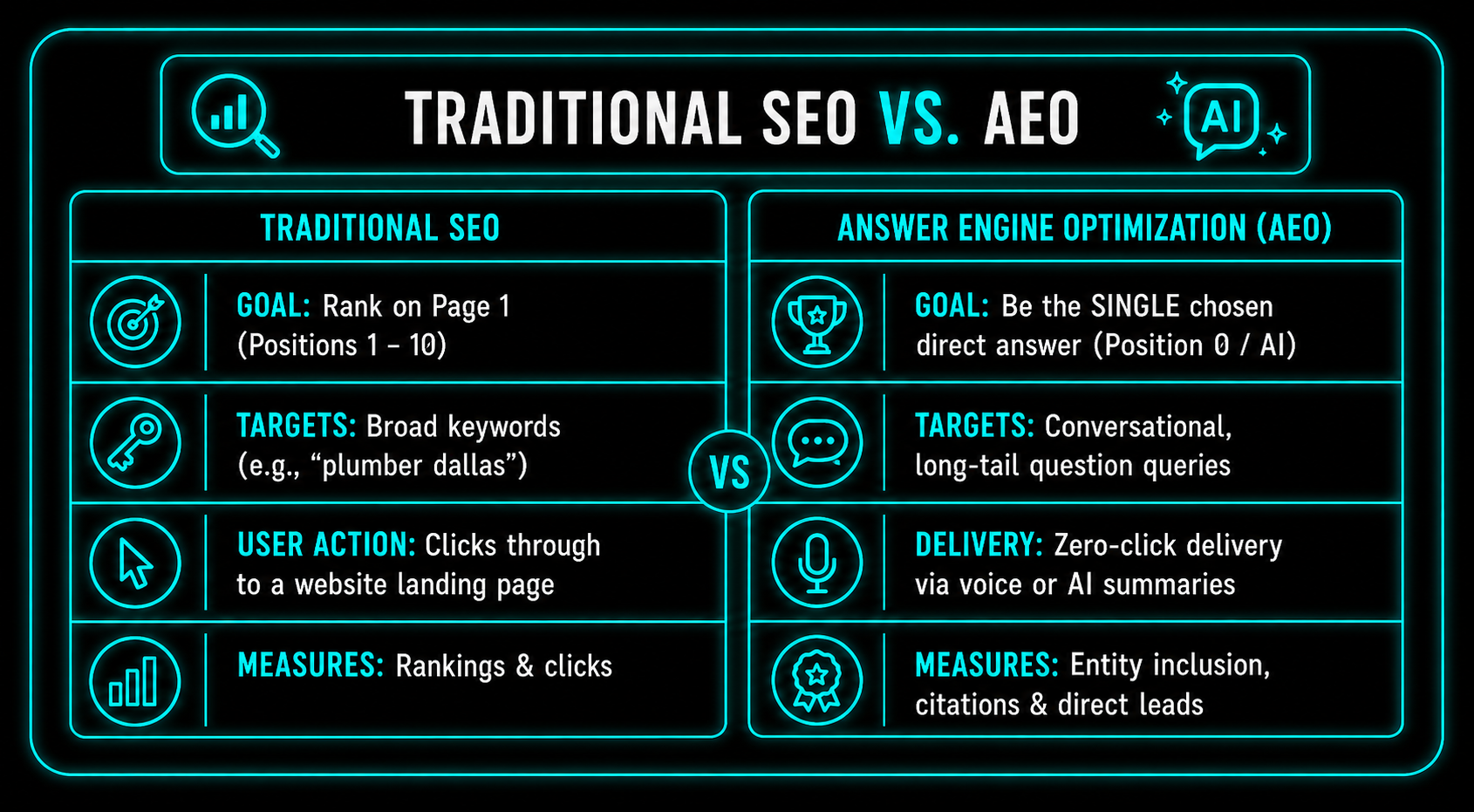
While traditional Search Engine Optimization (SEO) aims to bring traffic to your website through search results pages, AEO focuses on winning the direct answer slot. It translates your real-world expertise into structured data blocks that natural language processing (NLP) algorithms can easily extract, digest, and cite.
How Voice Assistants and AI Engines Select the “Winner”
Whether Alexa is answering a spoken query in a kitchen or Google AI Overviews is synthesizing a response on a smartphone screen, answer engines evaluate candidates using a strict four-stage filter:
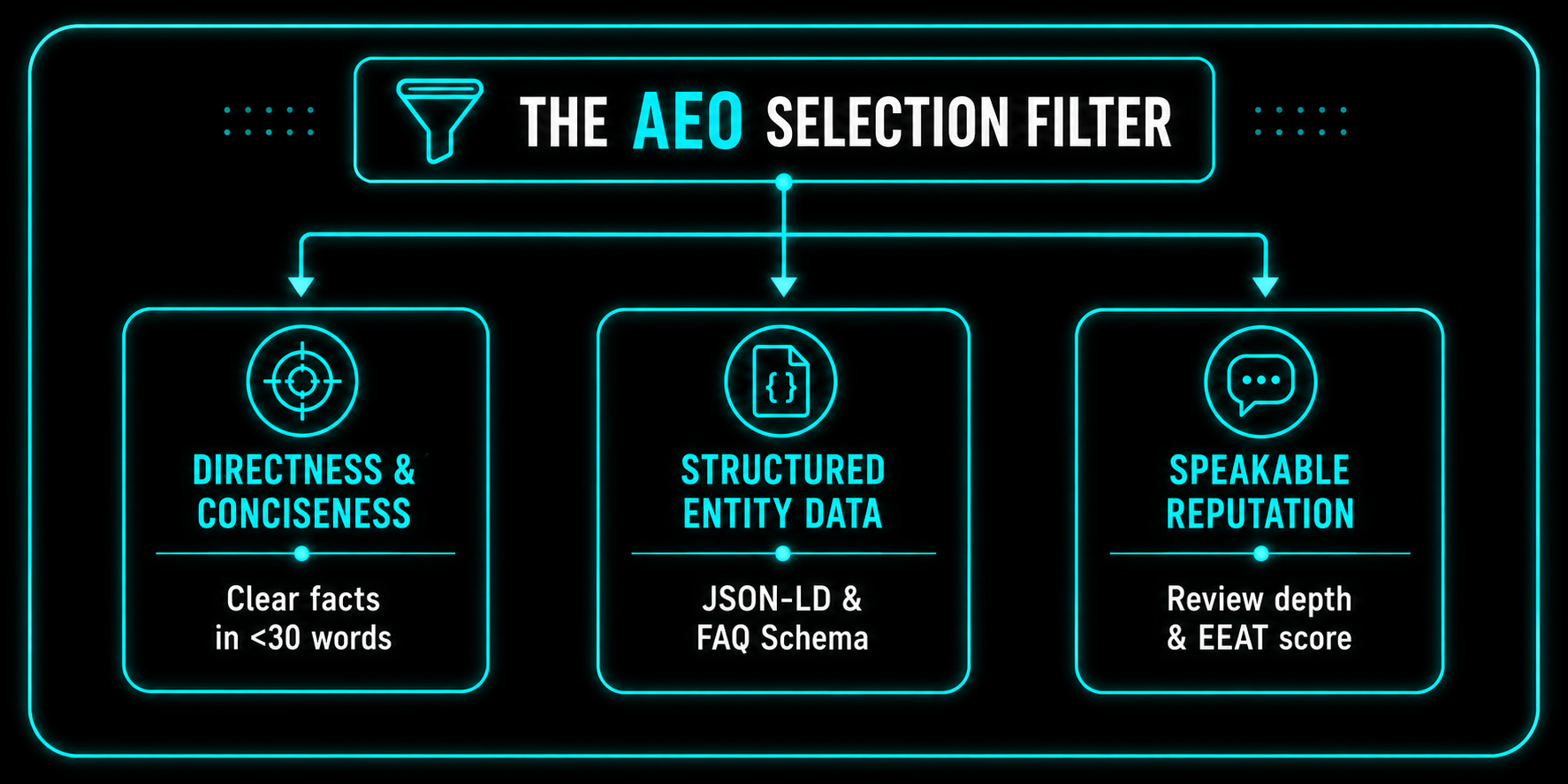
- Query Intent Matching: The AI analyzes the natural language of the voice query to extract core entities (e.g., service type, location, urgency, and pricing expectations).
- Entity Verification & EEAT Parsing: The engine scans web indexes for verified entities that demonstrate high Experience, Expertise, Authoritativeness, and Trustworthiness (E-E-A-T).
- Structured Answer Extraction: The AI extracts short, highly direct paragraphs, bulleted lists, or Markdown tables that answer the question without requiring paraphrasing.
- Voice Synthesizability & Speakable Parsing: For voice search (Siri, Alexa, Google Assistant), the engine selects content formatted for clear speech output avoiding complex jargon, long run-on sentences, or vague fluff.
💡 Is Your Brand Winning the AI Answer Slot?
AI search engines and voice assistants are making decisions for your customers right now. Find out if Siri, Alexa, or Google AI Overviews cite your business or send clients to competitors.
The 5 Pillars of Answer Engine Optimization (AEO)
To ensure your local service company wins voice search queries, zero-click answer blocks, and AI Overviews, you must implement these five technical and content pillars:
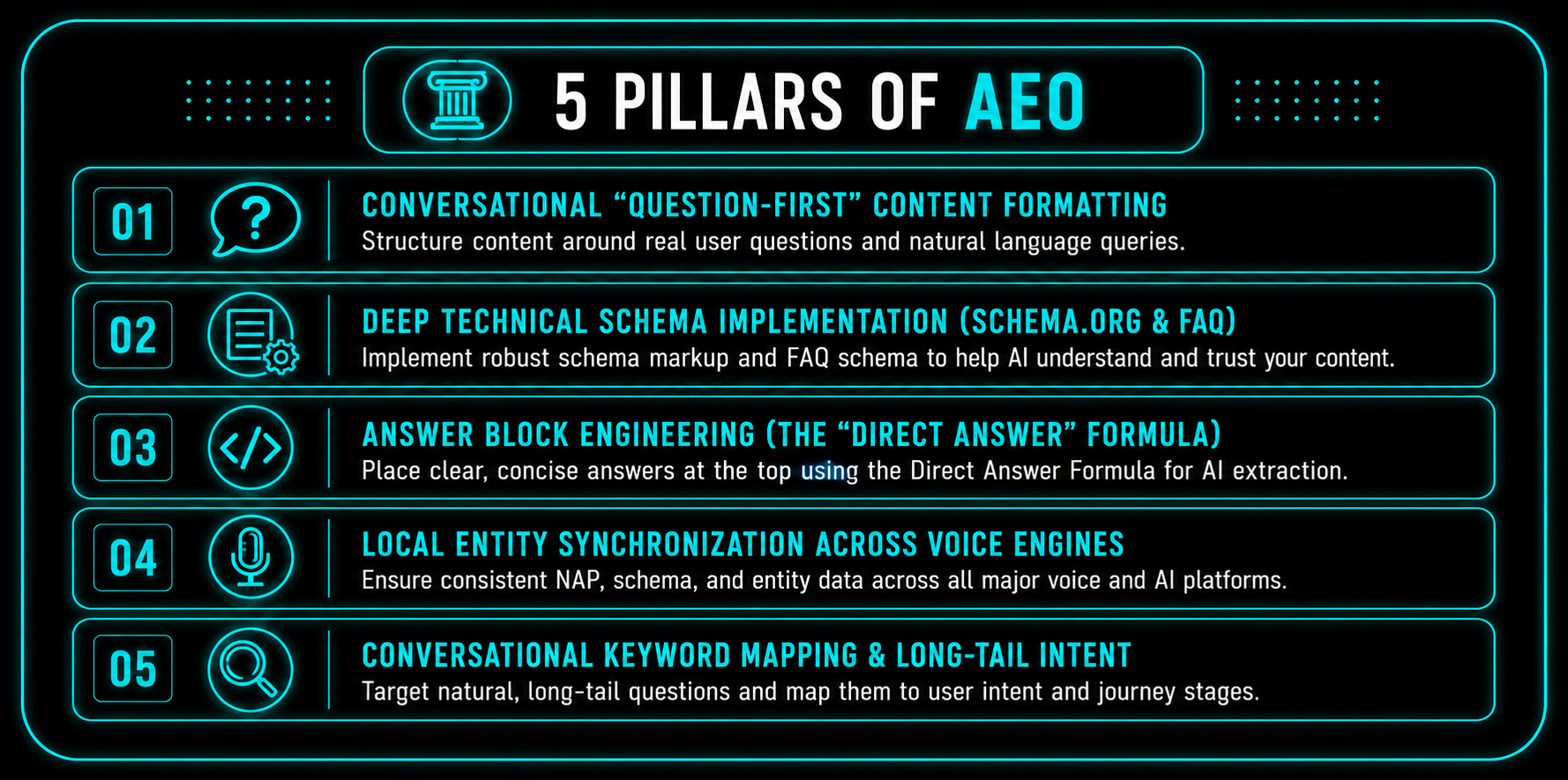
1. Conversational “Question-First” Content Formatting
Traditional SEO targeted head keywords like “plumber dallas tx” or “auto detailing miami.” AEO targets how human beings speak.
Your website content must feature H2 and H3 subheadings formatted as explicit, conversational questions that mirror exact voice queries:
- “How much does it cost to repair a leaking water heater in [City]?”
- “What is the difference between ceramic coating and paint protection film?”
- “Can an electrician fix a flickering home breaker panel on a weekend?”
2. Deep Technical Schema Implementation (Speakable & FAQ Schema)
Structured JSON-LD code acts as a translator between your website and search engines. For AEO, two Schema types are essential:
FAQPageSchema: Explicitly defines pairs of questions and answers so AI engines can extract answers without processing unstructured HTML.SpeakableSchema: Identifies specific textual blocks (such as concise summary paragraphs) best suited for audio playback by voice assistants like Siri and Google Assistant.
{
  "@context": "https://schema.org",
  "@type": "FAQPage",
  "mainEntity": [{
    "@type": "Question",
    "name": "How much does emergency furnace repair cost in Dallas TX?",
    "acceptedAnswer": {
      "@type": "Answer",
      "text": "Emergency furnace repair in Dallas TX typically costs between $150 and $450 for standard service calls. Complex component replacements, such as blower motors or heat exchangers, can range from $600 to $1,200 depending on system specifications."
    }
  }]
}
3. Answer Block Engineering (The “Direct Answer” Formula)
To earn citations inside Google AI Overviews or voice search responses, structure your text using the Inverted Pyramid Answer Formula:
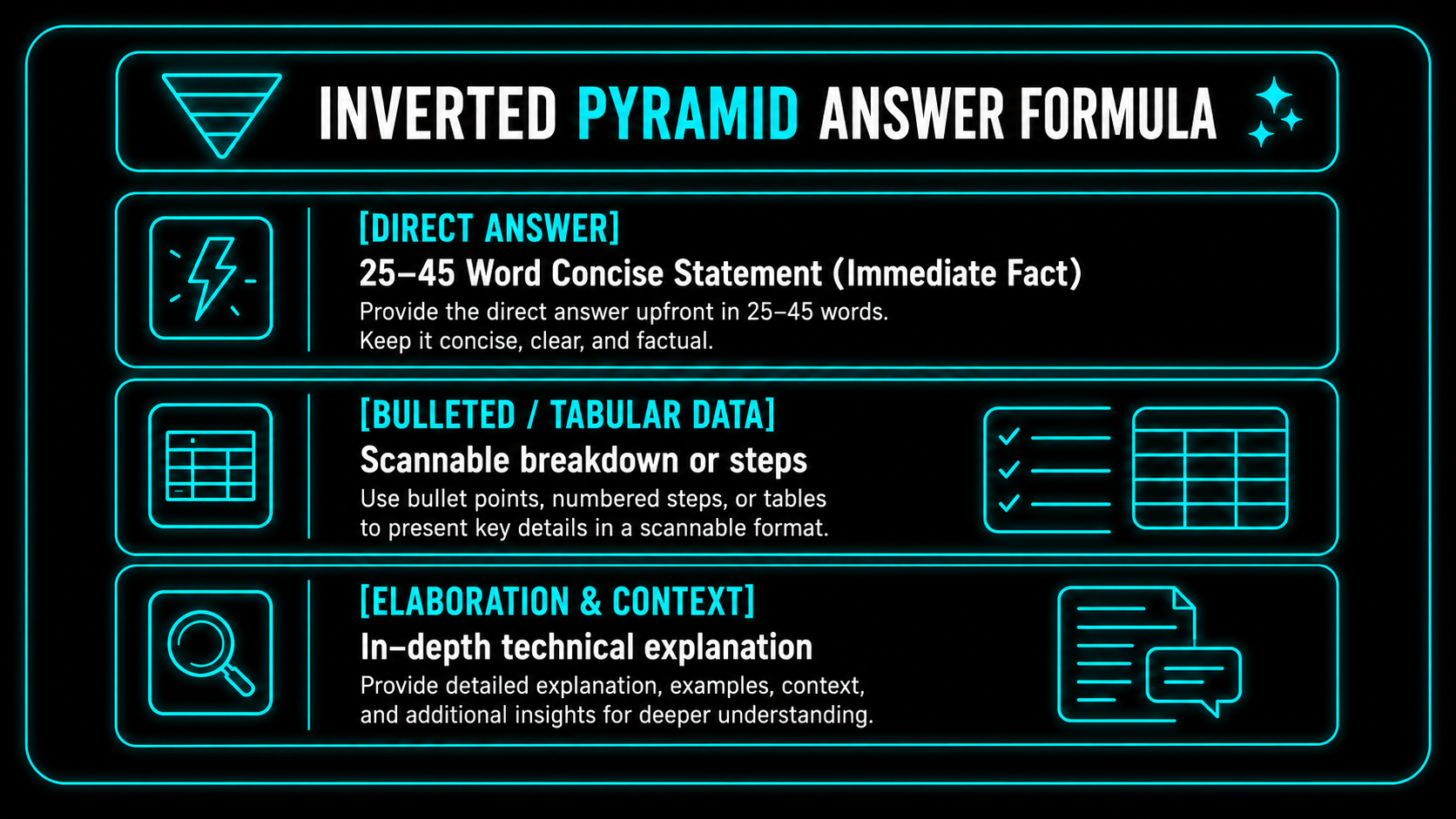
Place a clear 25-to-45-word direct answer immediately below your question heading. Follow it with bullet points or Markdown comparison tables that AI engines can easily extract into structured summary cards.
4. Local Entity Synchronization across Voice Engines
Voice search devices pull data from distinct mapping and knowledge engines:
- Apple Siri pulls local business data primarily from Apple Maps & Yelp.
- Amazon Alexa pulls from Bing Places, Yelp, & Yext.
- Google Assistant & Gemini pull directly from the Google Business Profile & Google Knowledge Graph.
If your Name, Address, and Phone Number (NAP) details or opening hours conflict across these platforms, voice engines will refuse to recommend your business due to low citation confidence.
5. Conversational Keyword Mapping & Long-Tail Intent
Map your content around conversational long-tail queries that capture implicit user urgency and local intent:
- Transactional Intent: “Who can fix a broken AC compressor today in [City]?”
- Comparative Intent: “Which is better for new cars: ceramic coating or wax?”
- Pricing Intent: “Average price per hour for an emergency electrician.”
Actionable AEO Execution Plan for Local Service Providers
Follow this step-by-step roadmap to optimize your plumbing, HVAC, auto repair, detailing, or electrical business for voice search and AI answers:
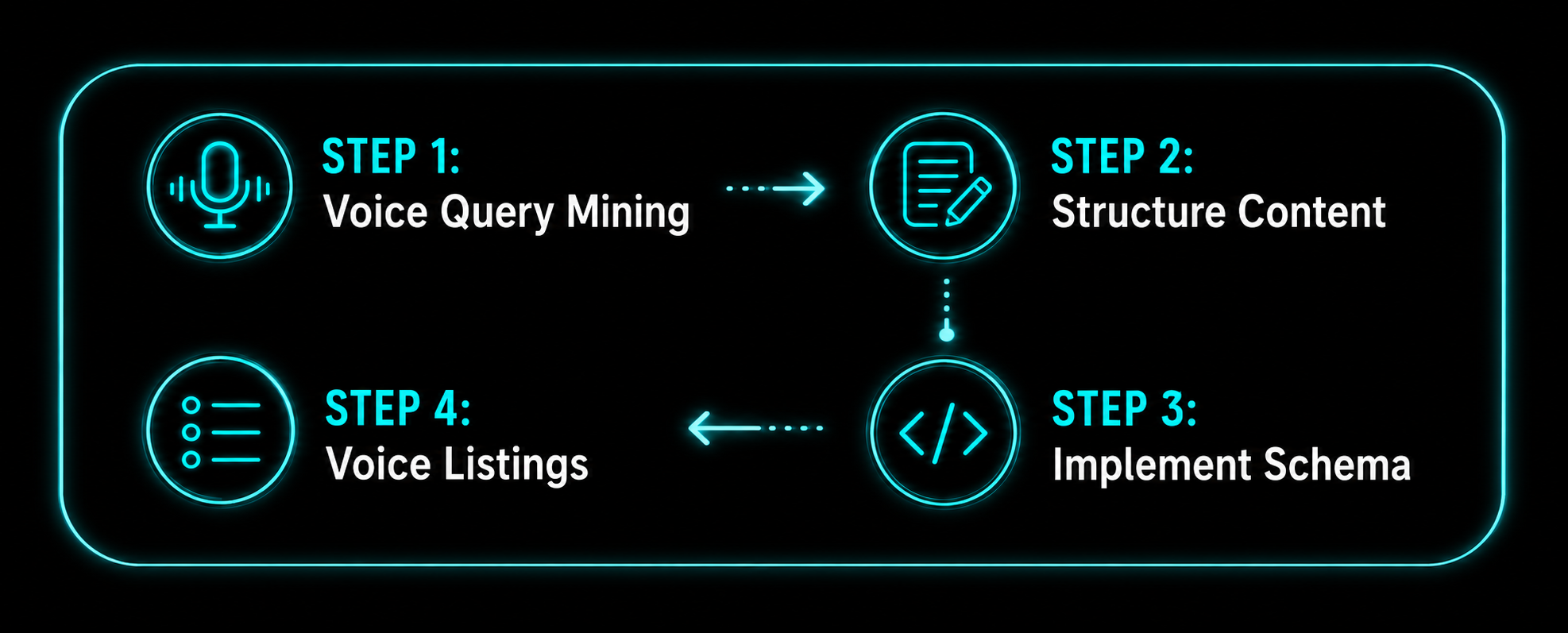
Step 1: Mine Real Customer Questions
Gather the exact natural-language questions your customers ask:
- Review incoming phone call recordings, contact form inquiries, and customer emails.
- Check Google’s “People Also Ask” (PAA) boxes for your primary service keywords.
- Extract conversational queries using search research tools.
Step 2: Build Structured “Direct-Answer” Service Pages
Redesign your core service pages to include dedicated FAQ sections. Ensure every question heading is followed by a concise 30-word direct answer, scannable bullet points, and clean comparison tables.
Step 3: Deploy Advanced JSON-LD Schema Markup
Add validation-tested FAQPage, LocalBusiness, and Service Schema markup to your pages. Test your code using official Schema validation tools to ensure search crawlers parse your entity data without errors.
Step 4: Claim & Sync Secondary Voice Search Directories
Claim and verify your business listings across Apple Maps, Bing Places, Yelp, and major data aggregators. Ensure your operating hours, phone numbers, and service descriptions are identical across all platforms.
📊 Don’t Lose Market Share to Zero-Click Searches
As zero-click searches grow, conventional SEO alone isn’t enough. Partner with a team that specializes in modern Answer Engine Optimization and AI search positioning.
How CodixMedia Helps You Win AI & Voice Search
At CodixMedia, we help local service providers, contractors, and automotive specialists across the USA navigate the shift from traditional keyword search to modern AI answer engines.
Our comprehensive growth solutions include:
- Answer Engine Optimization (AEO): Custom content restructuring, FAQ block engineering, and Speakable Schema deployment for AI search platforms.
- Generative Engine Optimization (GEO): Cross-platform brand positioning for ChatGPT, Perplexity, and Google Gemini.
- Google Business Profile Mastery: Complete Google Business Profile Management Services to secure Top 3 Map Pack rankings.
- High-Speed Web Development: Mobile-first, Schema-powered Website Development Services built for machine readability.
- Paid Media Acceleration: Targeted PPC Campaign Management to capture high-intent leads across all search formats.
Ready to Become the #1 Direct Answer in Your City?
Stop letting competitors claim the top AI summaries and voice search answers. Partner with an agency that understands how to structure your brand for long-term dominance across Google, Siri, Alexa, and ChatGPT.
👉 Schedule Your Strategy Call with CodixMedia Today or explore our proven track record on the CodixMedia Portfolio.